Posts

Time in the sun

Image
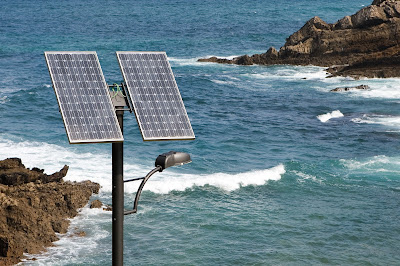
Continuing our series exploring alternative methods of power generation, including Micro-CHP and Surface Water Source Heat Pumps , we turn our attention to photo-voltaics (PV). This week, we explore the work done by   Dr. Cynthia Skelhorn, Qatar Green Building Council and Dr. Maria Muhlbauer, UnionBent GbR, Management Systems, Germany in determining the potential of PV in the two countries. All countries and forward-thinking governments are aiming to address two main issues in developing long-term energy policies.  First, from a demand perspective, they must consider how to decrease energy consumption by implementing energy efficiency policies and technologies. There are several benefits to this; it can lower the Government's own energy bills across the national portfolio of publicly owned buildings common to many countries, it can lower the household and business bills of a country's citizens, and it reduces a country's reliance on imported energy, increasing that cou...

Shedding new light

Image
LED lights are becoming more and more popular as a solution for local authorities in preference to older sodium and fluorescent alternatives, but what should procurement managers know before they take the plunge? Matt Snowden of CIBSE  takes a look. Having signed into law the next tranche of targets, which commit the country to reducing its carbon emissions by 57% relative to 1990 levels by 2030, the UK Government is stepping up its emphasis on sustainable policies designed to promote clean generation and greater efficiency. As well as a focus on renewable sources of power, these policies also include measures to improve the energy performance of the UK’s buildings, both current and yet to be built. It’s a sensible plan, because buildings make up a large percentage of the UK’s carbon footprint – accounting for nearly 40% of the nation’s greenhouse gas emissions and nearly 70% of electricity consumption, much of which is produced by carbon-heavy generation methods like gas, coal...

So you want to be published?

Image
The UK has one of the world's largest research industries, employing more than 60,000 people and worth over £3bn a year to the economy. Every researcher wants their material to be published in respected journals to be read, cited and acclaimed by their peers, but how do you get your work noticed in a crowded market?  Martin McDonald, Publishing Editor of Building Services Engineering Research and Technology (BSER&T) explains in this short guide.  CIBSE Members benefit from free access to  Building Services Engineering Research & Technology  and  Lighting Research & Technology   Publication is often the culmination of research and is an opportunity to present your work to the community, to justify your funding, to promote your institution, your research group and yourself. Impactful papers can make your name at an international level which can bring many opportunities both professionally and personally. It also allows you to influence po...

Zen and the art of BIM

Welcome to the third #Build2Perform podcast, where this month we're discussing Building Information Modelling (BIM) - its past, present and future. With me in the studio is BIM consultant Carl Collins , and we also hear from Jason Whittall, Director of One Creative Environments , at the recent CIBSE West Midlands 'BIM in action' seminar You can listen to the podcast below, but you can also find it in the iTunes library and on other podcast apps by searching #Build2Perform if you'd like to listen on the move via smartphone or tablet. We'll also be discussing the podcast on Twitter under the #Build2Perform, and you'll find useful links about what you hear under the podcast below. Building Information Modelling (BIM) has been around in various forms for many years, but there is often confusion about what exactly 'BIM' is, how engineers can use it on projects and who exactly is responsible for it. In his blog The Digital Engineer , BIM consultant ...

Pulling together

Image
In July 2014 the John Lewis store in York made history by becoming the first department store in the world to be awarded a BREEAM Outstanding rating – the highest category achievable under the BRE’s environmental and energy assessment method. This achievement was recognised at the 2016 CIBSE Building Performance Awards where the scheme won the Collaborative Working Partnership Award. Andy Pearson writes about the secrets to their achievements. The path to the team’s success started two years earlier in 2011, when JLP announced its commitment to reduce carbon emissions from a 2010 benchmark by 15% in absolute terms by 2020. This is an exceptionally challenging target when you factor in that the business is growing and adding new shops. To help achieve its objective the business set a carbon reduction target for its new shops of 30% less than existing similar shops. Inside York's award winning John Lewis store In 2012, JLP approached consulting engineers Lateral Technol...

Change and climate change

Image
The historic vote on 23rd June for the United Kingdom to leave the European Union will have wide ranging consequences. But what might Brexit actually mean when it comes to buildings, energy and the environment? In the first of a series of blogs Dr Hywel Davies, Technical Director of CIBSE , writes on the implications for UK climate change policy. Whilst much attention was, understandably, directed towards the result of the momentous vote on the 23 rd June, much more important for UK climate change legislation was an announcement on the 30 th of June, just a week later. On that day the government committed to the emissions reductions targets recommended by the Committee on Climate Change (CCC) for the fifth carbon budget, 2028 – 2032, which sets out to reduce UK greenhouse gas emissions in 2030 by 57% relative to 1990 levels. The CCC has also recently published its 2016 Annual Progress Report to Parliament detailing UK progress in reducing greenhouse gas emissions and meeting car...

Zero hour

Image
Following the publication of Guide B early in July Matt Snowden, Communications Executive of CIBSE , explores the new Guide's Part 0, the rationale behind it, and how it could affect the industry as a whole. To use a tired old metaphor, writing CIBSE guidance is a bit like painting the Forth Bridge. Or it would be, if engineers hadn’t solved that problem too by using a pioneering new glass flake epoxy paint to ensure the famous crossing doesn’t need another coat until 2031. It’s this same constant engineering innovation that necessitates revision of CIBSE Guides to ensure they always stay as up to date as possible with the latest changes in technology and legislation. Such is the case with Guide B which, until it was launched earlier this month , hadn’t been totally replaced since 2001. Obviously a lot has changed since then, and even since its last update in 2005 there have been fundamental changes in the industry – the European Energy Performance of Buildings Directive (EPBD)...